
Fundamental Definitions
If you try to Google about action research, most of them will cover topics about school. It is most effective to be implemented in the academic field to improve some methods of learning or teaching. But before getting deep in to the academic area of action research, I will cover some fundamentals about action research and the idea of how it is conducted.
Sagor (2000) stated, “action research is a disciplined process of inquiry conducted by and for those taking the action. The primary reason for engaging in action research is to assist the actor in improving and or refining his actions”. Sagor’s concept of action research perfectly illustrate the idea of a cycle of progress to improve some aspects as the main purpose of the research.
Action research is done and for the actor themself through improving and refining their actions. Thus, the researchers themself are the one who benefits from the result of the research. The cycle process of action research is aimed to create a quick and efficient process of trial and error on the method refinement.
Fundamentally, action research is based on an empirical process where observation and experimentation are the main method, rather than thorough planning and detailed processes. If we could compare it to different research methods, it has similarities to participant observational research where the researcher itself will conduct the research inside the research environment. Another one is design-based research where there is also a cycle process of extracting knowledge until it becomes a solid idea.
Characteristics
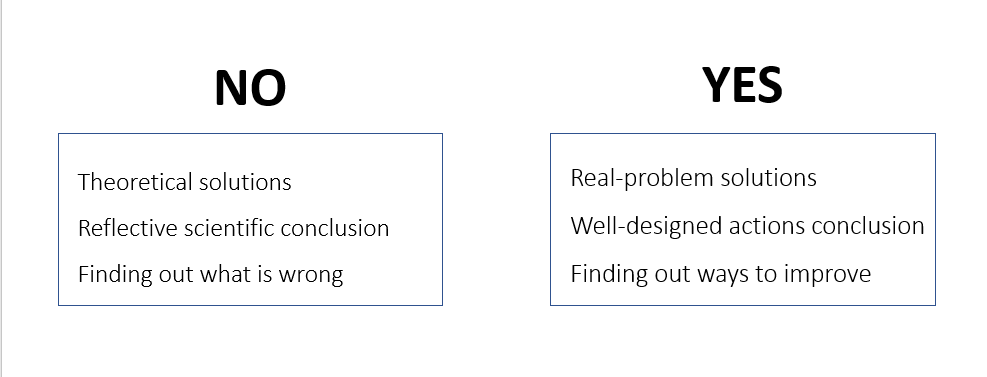
Action research addresses specific problem happening in an environment. It aims to find solutions to a struggle occuring in some sectors. It does not aim to find theoretical solutions out of the research. For example, finding solutions to increase average math scores in a class.
Some other characteristic about action research is that the purpose of the research is not to find a reflective scientific conclusion, but it is creating a well-designed course of actions. And the reason behind conducting an action research is not to find flaws, but to create ways to improve.
The Cycle
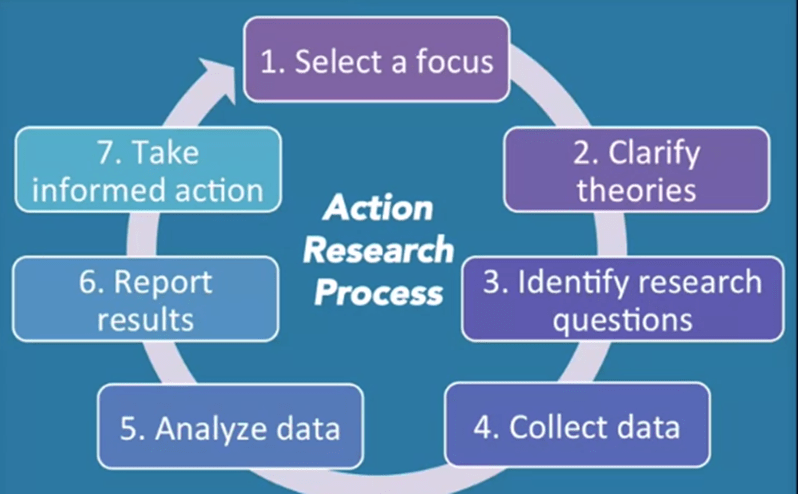
Selecting a focus is the most important part of the process as it would minimize the scope as specific as possible to increase the quality of the outcome. We would not want to have the topic of the research getting out of hand. Next is exploring theories, concept or values to approach the topic.
We would also need to identify research questions to guidethe research in line with the main scope. Then, comes the data collection where researchers need to accumulate data with evaluating their reliability and validity. Next, the collected data will be identified regarding trends and patterns and finding the root of the problem. Thus it comes to the finalizing part of the process where the data are summarized in a report and the important part is implementing the newly created methods or actions.
Like I have explained earlier, the process is in a form of cycle which will consist of trials and errors to establish a well-designed methods. After all the process completes, it all goes back to the first step which is selecting the research focus on new problems.
Academic Environment
Action research is mostly conducted in the academic environment where teachers and/or their colleagues are included in the process. They will aim to solve problems occurring in schools and classes through establishing a better technique and methods in teaching.
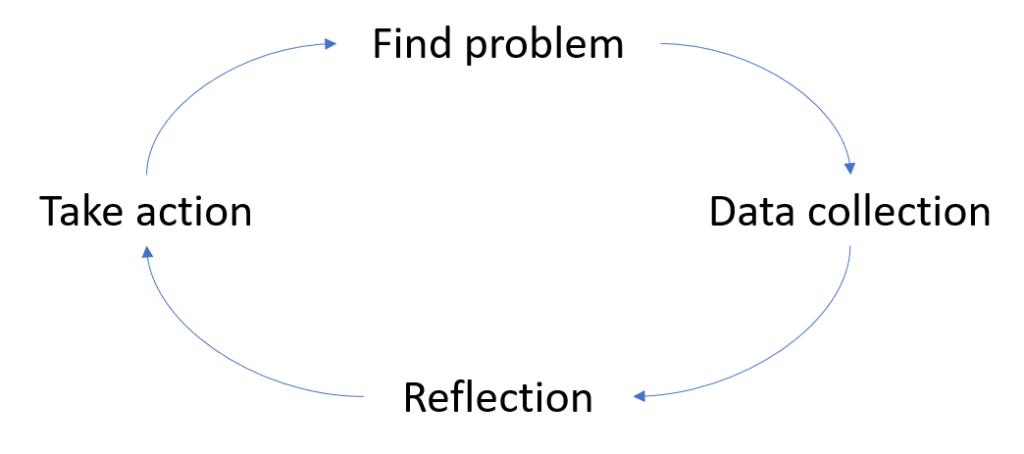
The purpose of action research is not always to solve problems in a certain area, it could only be aimed to improve some aspects of teaching. A cycle shown on figure 3 represents the same concept as Sagor’s cycle process on action research. It starts with finding the scope of the research and creating guidelines for it. Then it continues to acquiring data process and analyzing it while creating reflections out of it. And from the summary of all the processed data, a conclusion in the form courses of actions will be implemented in the school.
IT Implementations
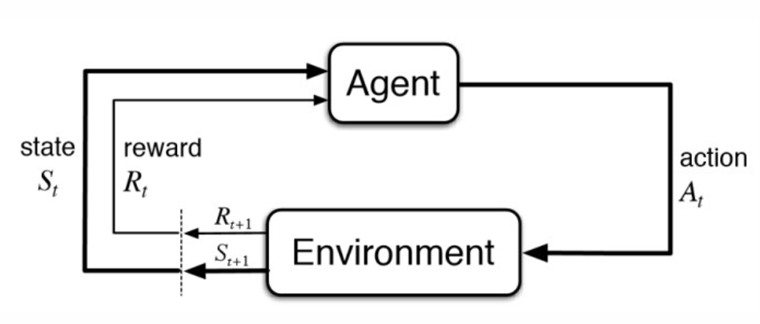
A similar concept of action research is also used in several area in IT. One of them is one the paradigm of machine learning which is reinforcement learning. This paradigm’s agent uses the same idea of action research of cycle processes of trial and error to reach the optimal solution for a problem. The characteristic of reinforcement learning is that the agent does not know what to expect from the outcome of its action, it is only programmed to aim for the highest score possible.
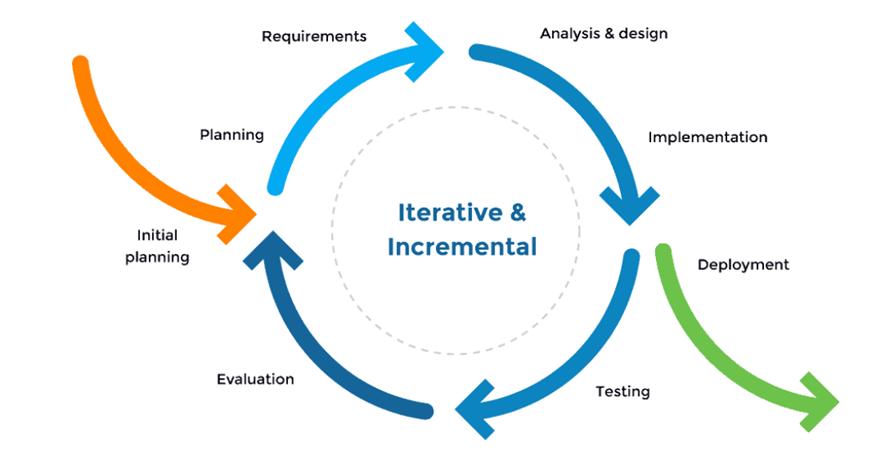
Another idea of action research that could be implemented in IT is one of the method of software development life cycle which is the iterative and incremental life cycle. It follows the same plan as a waterfall life cycle, however it goes through cycles of planning to analysis to testing and evaluation. It creates a cycle of trial and error of the planning and testing to create a better design for the software which then be ready for deployment.

 Marcellus's Blog
Truly excellent posting 🙂
LikeLike