
IoT Printer as Emerging Technology
Our team have chosen IoT as the emerging technology to implement the framework with. After more discussion with the team, we have decided to go with an IoT printer. The idea of this printer is that it is equipped with a tracking sensors to measure its available resources, such as ink and papers. Inventory would also be monitored thus reducing the need to manually check available resources all the time. It will also have the ability to warn the administrator or operator automatically when the resources are getting low.
IoT printer reference: https://www.entrepreneur.com/article/338499
COBIT 5 Intro
To get in to the report, I need to identify the concept of COBIT 5 in more detail. Thus, in this and the next post, I will try to cover the core principles of COBIT 5 also as my guideline to help assess the emerging technology with this framework. I use this approach to get the core concept on COBIT 5 and to ensure the implementation follows the framework.
As I have mentioned in previous posts, I have been assigned to identify COBIT 5 framework in more details and integrate with our chosen emerging technology. I have also learned the broad idea of COBIT 5. Though COBIT 5 mostly covers a business approach where CIO or CTO mostly might need, it has the idea of governing IT service and manages it with wide variety of processes that creates a value for the business.
COBIT 5 aims to achieve strategic goals through enhancing its operational function of technology. It also balances the efficiency on an IT service to have maintained risk in its best cost efficient method. With its worldwide acknowledgement, this framework covers the principles, pactices, tools and guidelines to the trust and value in the IT service. This creates a sustainable framework to help achieve all internal or external stakeholders to business objectives and strategy.
COBIT 5 Benefits
Failure to adopt COBIT 5 in a company could result a disturbance in a lot of processes for the business. As COBIT 5 helps create a regulations framework which are accepted by external agencies or regulators. In addition, corporate standards and policies guided by COBIT 5 are established for the organization.
Aligning the IT and business objectives are also the main benefit of COBIT 5. Having an effective and aligned strategy for IT services through governance, it enables IT servies to innovate and deliver value improvement for the business. Also with the governance and management controlled in the framework, it helps administer IT assets and its cost efficiently.
COBIT 5 Governance Objective
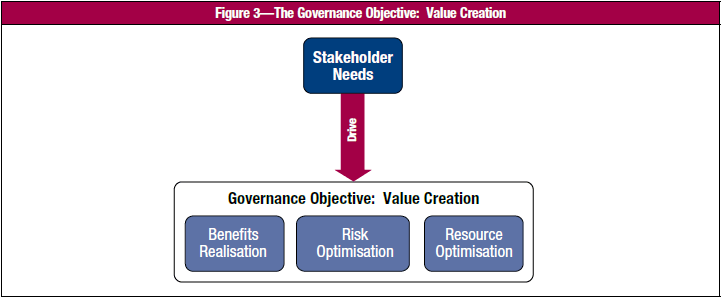
COBIT 5 is a top-down approach to a company in which is based on stakeholder needs, it determines what management processes are required. Every IT services in enterprises will create different and unique framework as different businesses will have different stakeholder needs. These are done by optimising the balance on value of IT services through 3 drivers which are Benefits Realisation, Risk Optimisation and Resource Optimisation. To understand more about these 3 drivers we could ask some question to know more about its idea:
- Benefits Realisation – For whom are the benefits?
- Risk Optimisation – Who bears the risk?
- Resource Optimisation – What resources are required?
While balancing these 3 drivers and also considering stakeholderneeds, it establishes the governance objective of value creation.
COBIT 5 Principles

I have mentioned these 5 principles of COBIT 5 in my previous post. Here, I will get in to more detail of what each principles represents in COBIT 5 and its implementation in a company.
Principle One
All stakeholders of enterprises, whether it is the external or the internal, expect a company to generate a value which need to be fulfilled. These needs are often found to be conflicting internally or even with the organizational aspects. COBIT 5 suggests the use of a customised goals cascade which directs the high-level enterprise goals to a managable and specific IT-related goals thus enabling to map the processes needed for the enterprise.
Principle Two
COBIT 5 covers all functions and processes accross the company also taking IT governance into account of the enterprise governance. This creates what COBIT 5 call a Governance Approach which would also help align the latest views on governance. Other than that, internal and external IT services as well as business processes are included in COBIT 5.

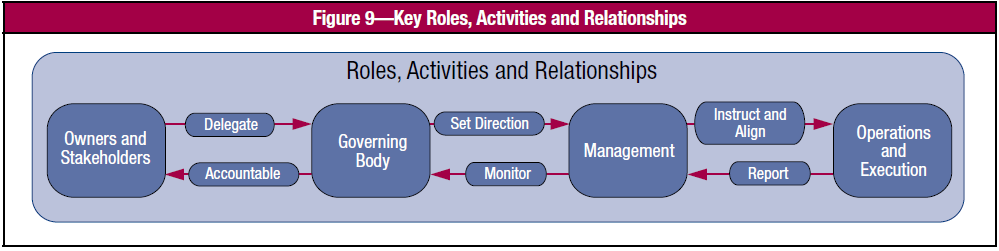
The governance approach are supproted by 4 main elements which are governance objective, governance enablers, governance scope and roles activities and relationships. Enablers are the organisational resources which influences governance actions to achieve the objective. Scope would be the size of coverage of the framework. Roles, activities and relationships defines and differentiate governance and management entities as well as its actions towards one antoher.
This is will be the end of this post. For next week, I will learn and share more on the other principles of COBIT 5.

 Marcellus's Blog